
Generating Sheet-Metal Bracket Variants Under Manufacturing Constraints
An automotive tier-1 supplier produces several hundred bracket variants a year, most of them minor adaptations of an existing design to a new mounting position.
Run on Shilpa · Engineering Automation
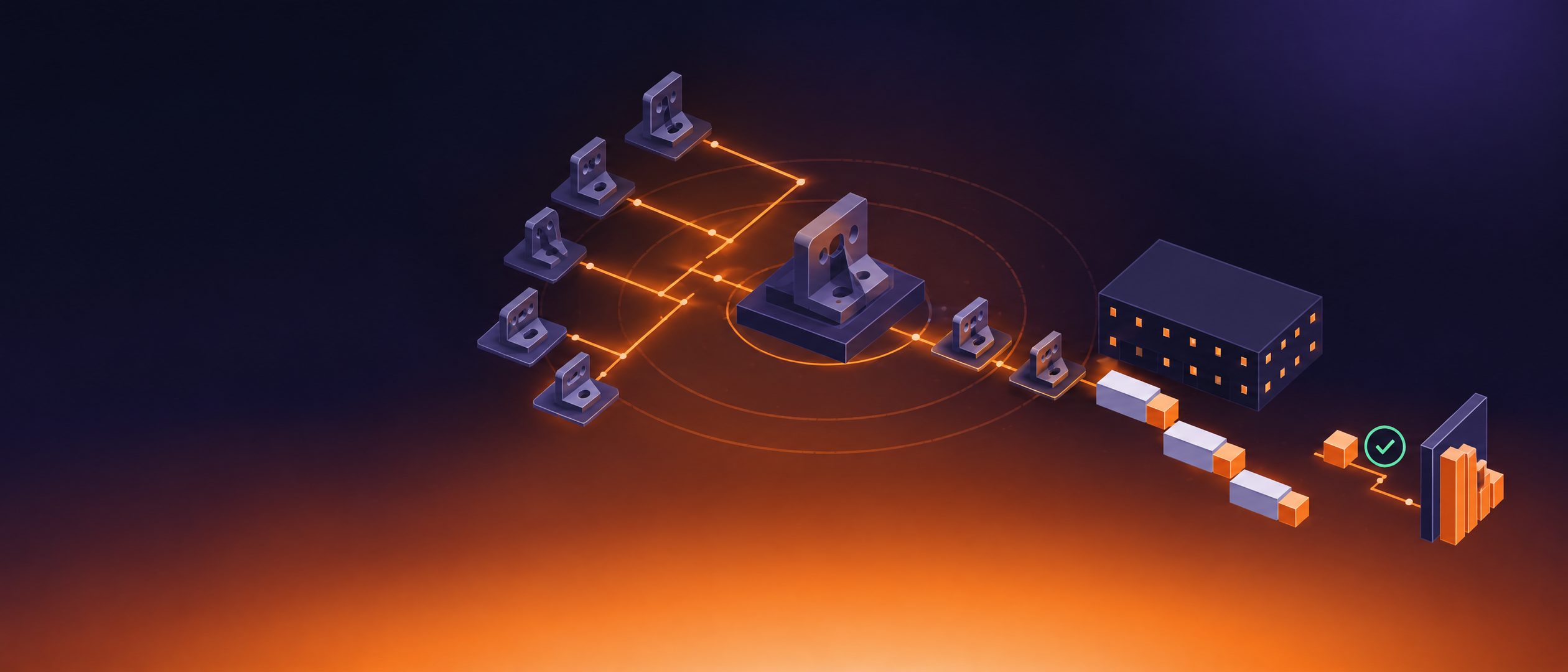
Experienced engineers spend a large share of their week on adaptations that require judgement but not creativity.
Intent Capture → Constrained Generation → Manufacturability Check → Family Consistency
Routine adaptation work reduced to review rather than modelling.
The challenge
Experienced engineers spend a large share of their week on adaptations that require judgement but not creativity.
Manufacturability problems such as bend radius and tool access are found at quoting, after the design work is done.
Each engineer solves the same adaptation slightly differently, so the family drifts apart over time.
How our team solved it, with Shilpa
- 01
Intent Capture
The engineer states the change in engineering terms, such as mounting position, load case, and material, rather than modelling it feature by feature.
- 02
Constrained Generation
Shilpa generates candidate geometry inside the existing CAD system, respecting the family's established design rules.
- 03
Manufacturability Check
Bend radius, tool access, nesting efficiency, and minimum flange length are validated before the design leaves the engineer's screen.
- 04
Family Consistency
Generated variants are checked against the existing family so the design language does not drift.
- 05
Engineer Review
The engineer accepts, adjusts, or rejects each variant, and nothing reaches release without that decision.
The outcome
- Experienced engineers spend a large share of their week on adaptations that require judgement but not creativity.
- Manufacturability problems such as bend radius and tool access are found at quoting, after the design work is done.
- Each engineer solves the same adaptation slightly differently, so the family drifts apart over time.
- Routine adaptation work reduced to review rather than modelling.
- Manufacturability problems caught during design instead of at quoting.
- Variant families that stay consistent as they grow.
Delivered for a client; the client name is withheld under NDA. References are available on request.
Capabilities used
Every accelerator is assembled from the same capability layer, so a workflow you adopt here shares its foundation with the rest of the portfolio.
Run on Shilpa
Watch Shilpa run, end to end, in a few minutes.
GenAI for CAD automation and manufacturing engineering.
See the Shilpa acceleratorMore from Shilpa

Capturing Retiring Engineers' Design Rules as Reusable Assets
A heavy machinery manufacturer faces a wave of retirements among the engineers who hold three decades of undocumented design judgement.
Read the use case
Early Manufacturability Feedback on Cast Housing Designs
A pump manufacturer designs cast housings whose manufacturability problems - draft angles, wall thickness transitions, core support - surface only when the foundry quotes.
Read the use case
Accelerating Change Propagation Across a Product Family
An industrial equipment maker changes a shared interface dimension and must propagate that change across forty derivative designs built on it.
Read the use caseBring us the version of this that you actually have.
Every engagement is fixed in scope and milestone-gated. The scoping conversation starts with your systems, not with a template.