
Root-Cause Isolation via Bidirectional Traceability in Industrial Automation
A manufacturer of industrial Variable Frequency Drives (VFDs) and power control modules produces high-voltage power conversion units for water treatment facilities and automated factory floors. Each drive undergoes rigorous end-of-line electrical testing before field installation.
Run on Anvaya · Production Execution & Traceability

A field failure is reported for an installed VFD (Serial # VFD-9021-X) that suffered a thermal power stage breakdown after 100 hours of operation.
Backward Serial Traceability → Vendor Defect Correlation → Forward Trace to Active WIP → Inline WIP Identification
Investigation time from field failure report to root-cause isolation drops from 5 days to 20 minutes.
The challenge
A field failure is reported for an installed VFD (Serial # VFD-9021-X) that suffered a thermal power stage breakdown after 100 hours of operation.
Quality engineers must quickly determine whether the failure was caused by shop-floor assembly error, incorrect test parameters, or a defective vendor component lot.
Legacy traceability is strictly unidirectional; finding whether other active WIP jobs contain components from the same suspect batch requires opening hundreds of physical job jackets.
How our team solved it, with Anvaya
- 01
Backward Serial Traceability
Quality engineers enter Serial # VFD-9021-X into Anvaya Bidirectional Traceability, which traces back to the power MOSFET lot used in assembly, Lot # MOSFET-441-A.
- 02
Vendor Defect Correlation
Component test data confirms that Lot # MOSFET-441-A has a latent silicon gate defect from the semiconductor vendor.
- 03
Forward Trace to Active WIP
Engineers switch to forward tracing from Lot # MOSFET-441-A, and Anvaya searches all active shop-floor work orders.
- 04
Inline WIP Identification
Anvaya flags three active production orders on the assembly line that contain MOSFETs from the defective batch.
- 05
Supervisor Containment Decision
Quality supervisors approve a hold on the affected orders and send rework instructions to operator workstations before final potting and box-build.
The outcome
- A field failure is reported for an installed VFD (Serial # VFD-9021-X) that suffered a thermal power stage breakdown after 100 hours of operation.
- Quality engineers must quickly determine whether the failure was caused by shop-floor assembly error, incorrect test parameters, or a defective vendor component lot.
- Legacy traceability is strictly unidirectional; finding whether other active WIP jobs contain components from the same suspect batch requires opening hundreds of physical job jackets.
- Investigation time from field failure report to root-cause isolation drops from 5 days to 20 minutes.
- 48 defective VFD units currently in production are intercepted and reworked before shipping to customer sites.
- The manufacturer submits an indisputable, data-backed warranty claim to the semiconductor vendor, recovering 100% of material rework costs.
Delivered for a client; the client name is withheld under NDA. References are available on request.
Capabilities used
Every accelerator is assembled from the same capability layer, so a workflow you adopt here shares its foundation with the rest of the portfolio.
Run on Anvaya
Watch Anvaya run, end to end, in a few minutes.
Every order traced from raw material to finished unit, in one genealogy view.
See the Anvaya acceleratorMore from Anvaya

Shop-Floor Bottleneck Prevention and WIP Queue Control
A high-mix, medium-volume industrial equipment manufacturer produces heavy hydraulic manifolds and valve block assemblies for mining and earthmoving machinery. Their plant operates across six discrete production stages: CNC machining, deburring, ultrasonic cleaning, valve spool fitting, high-pressure hydraulic testing, and final painting. The plant handles dozens of concurrent customer orders with strict delivery windows and contract penalties for late delivery.
Read the use case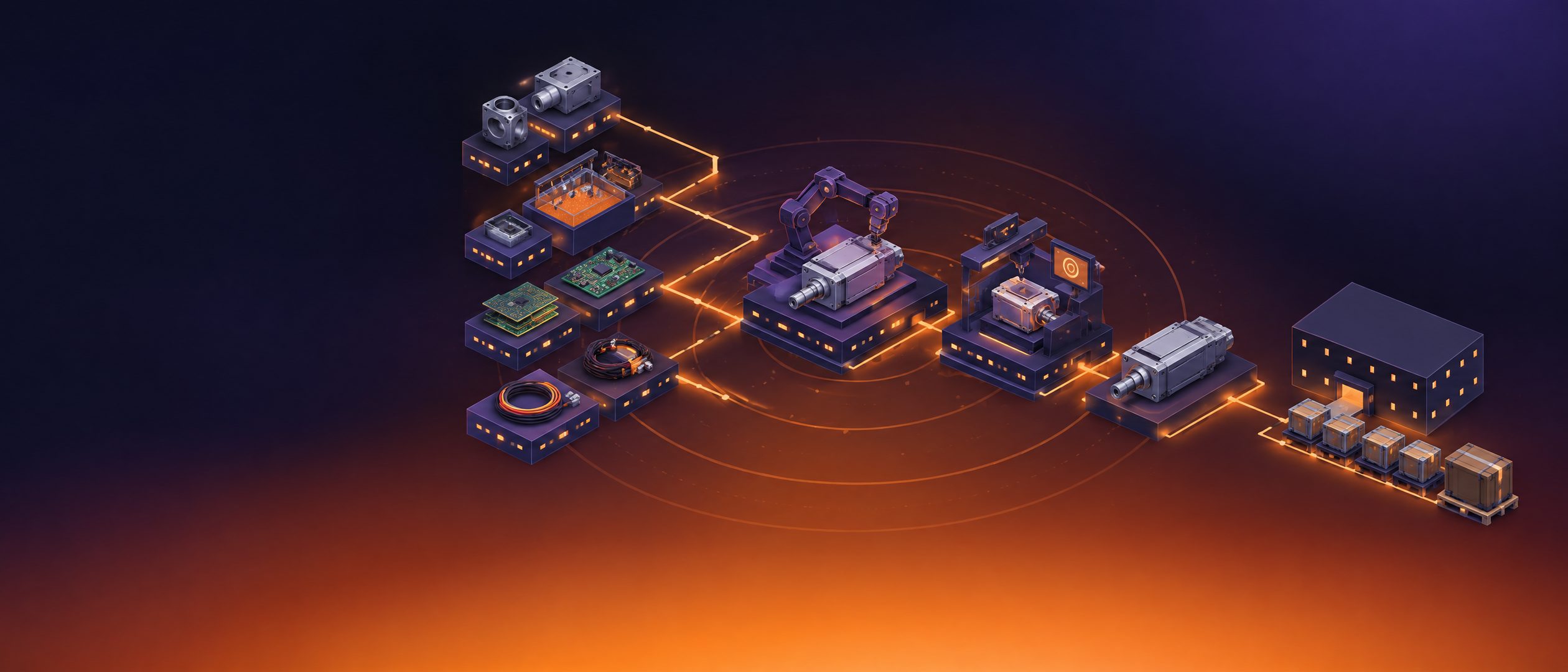
Multi-Tier Product Genealogy for Aerospace Subsystems
A Tier-1 aerospace supplier manufactures electromechanical flight-control actuators, integrating precision machining, surface treatment, multi-layer printed circuit board assemblies (PCBAs), and structural wire harnesses. Each completed actuator must comply with AS9100 safety and quality standards, requiring 100% verifiable component provenance across all assembly levels.
Read the use case
Instant Recall and Targeted Population-at-Risk Isolation for Medical Devices
An ISO 13485-certified medical device manufacturer produces portable patient monitoring units containing sensitive microprocessor boards and rechargeable lithium power modules. Production involves high-volume SMT PCBA assembly followed by multi-stage device integration and burn-in testing.
Read the use caseBring us the version of this that you actually have.
Every engagement is fixed in scope and milestone-gated. The scoping conversation starts with your systems, not with a template.