
Shop-Floor Bottleneck Prevention and WIP Queue Control
A high-mix, medium-volume industrial equipment manufacturer produces heavy hydraulic manifolds and valve block assemblies for mining and earthmoving machinery. Their plant operates across six discrete production stages: CNC machining, deburring, ultrasonic cleaning, valve spool fitting, high-pressure hydraulic testing, and final painting. The plant handles dozens of concurrent customer orders with strict delivery windows and contract penalties for late delivery.
Run on Anvaya · Production Execution & Traceability

A sudden influx of custom valve spool orders causes a severe, silent backlog at the spool fitting workstation.
Live Queue Monitoring → Bottleneck Detection → Affected Order Isolation → Planner-Led Replanning
Testing and assembly lines operate without interruption, preventing schedule slippage across 14 high-value customer orders.
The challenge
A sudden influx of custom valve spool orders causes a severe, silent backlog at the spool fitting workstation.
Planners rely on end-of-shift paper traveler sheets and once-daily ERP batch updates, catching bottlenecks only after downstream assembly lines run out of parts.
Floor expediters scramble via phone calls and whiteboards to authorize costly overtime without clear visibility into machine capacity or true order priority.
How our team solved it, with Anvaya
- 01
Live Queue Monitoring
Anvaya shows job movement across all workstations on the live Production Timeline and tracks cycle times and queue volumes.
- 02
Bottleneck Detection
Anvaya flags the valve spool fitting workstation as a severe constraint before downstream assembly cells run out of WIP.
- 03
Affected Order Isolation
Planners use Order Tracking to filter the 14 active production orders queued at or routing through the spool fitting station.
- 04
Planner-Led Replanning
Planners review live utilization across alternative work centers in Anvaya and approve a new sequence that moves standard spool fitting to secondary stations and keeps the primary station for custom jobs.
- 05
Schedule Dispatch
The approved schedule goes straight to shop-floor operator terminals, replacing paper travelers and phone calls.
The outcome
- A sudden influx of custom valve spool orders causes a severe, silent backlog at the spool fitting workstation.
- Planners rely on end-of-shift paper traveler sheets and once-daily ERP batch updates, catching bottlenecks only after downstream assembly lines run out of parts.
- Floor expediters scramble via phone calls and whiteboards to authorize costly overtime without clear visibility into machine capacity or true order priority.
- Testing and assembly lines operate without interruption, preventing schedule slippage across 14 high-value customer orders.
- Floor expediting and unplanned overtime costs drop by ~85% through automated queue monitoring and proactive capacity balancing.
- Zero SLA late-delivery penalty charges are incurred during peak production volume.
Delivered for a client; the client name is withheld under NDA. References are available on request.
Capabilities used
Every accelerator is assembled from the same capability layer, so a workflow you adopt here shares its foundation with the rest of the portfolio.
Run on Anvaya
Watch Anvaya run, end to end, in a few minutes.
Every order traced from raw material to finished unit, in one genealogy view.
See the Anvaya acceleratorMore from Anvaya
Multi-Tier Product Genealogy for Aerospace Subsystems
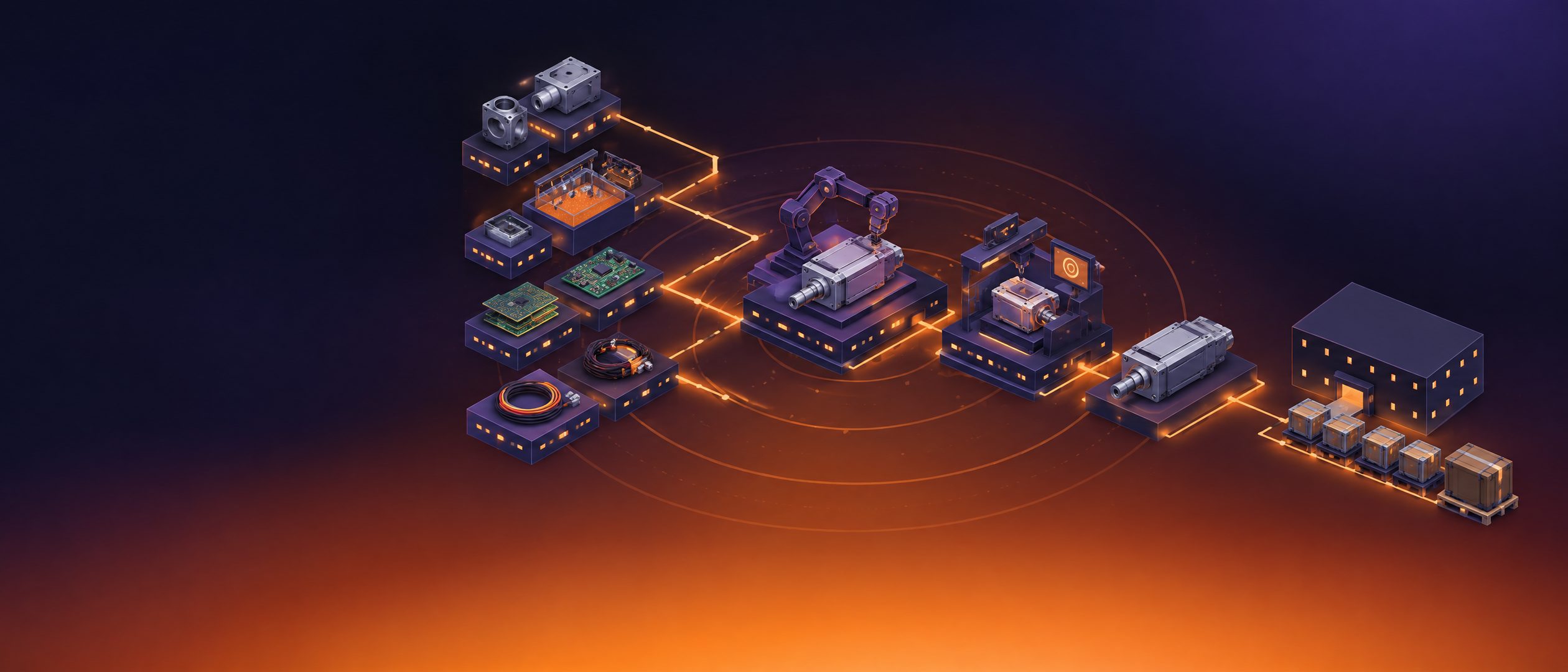
A Tier-1 aerospace supplier manufactures electromechanical flight-control actuators, integrating precision machining, surface treatment, multi-layer printed circuit board assemblies (PCBAs), and structural wire harnesses. Each completed actuator must comply with AS9100 safety and quality standards, requiring 100% verifiable component provenance across all assembly levels.
Read the use case
Instant Recall and Targeted Population-at-Risk Isolation for Medical Devices
An ISO 13485-certified medical device manufacturer produces portable patient monitoring units containing sensitive microprocessor boards and rechargeable lithium power modules. Production involves high-volume SMT PCBA assembly followed by multi-stage device integration and burn-in testing.
Read the use case
Root-Cause Isolation via Bidirectional Traceability in Industrial Automation
A manufacturer of industrial Variable Frequency Drives (VFDs) and power control modules produces high-voltage power conversion units for water treatment facilities and automated factory floors. Each drive undergoes rigorous end-of-line electrical testing before field installation.
Read the use caseBring us the version of this that you actually have.
Every engagement is fixed in scope and milestone-gated. The scoping conversation starts with your systems, not with a template.