
AI Assisted Failure Mode Discovery & Prevention Across Subsystems
A precision surgical robotics manufacturer developing a multi arm laparoscopic robotic surgery console with haptic feedback and stereoscopic visualization.
Run on Tatvam · Design Risk & FMEA
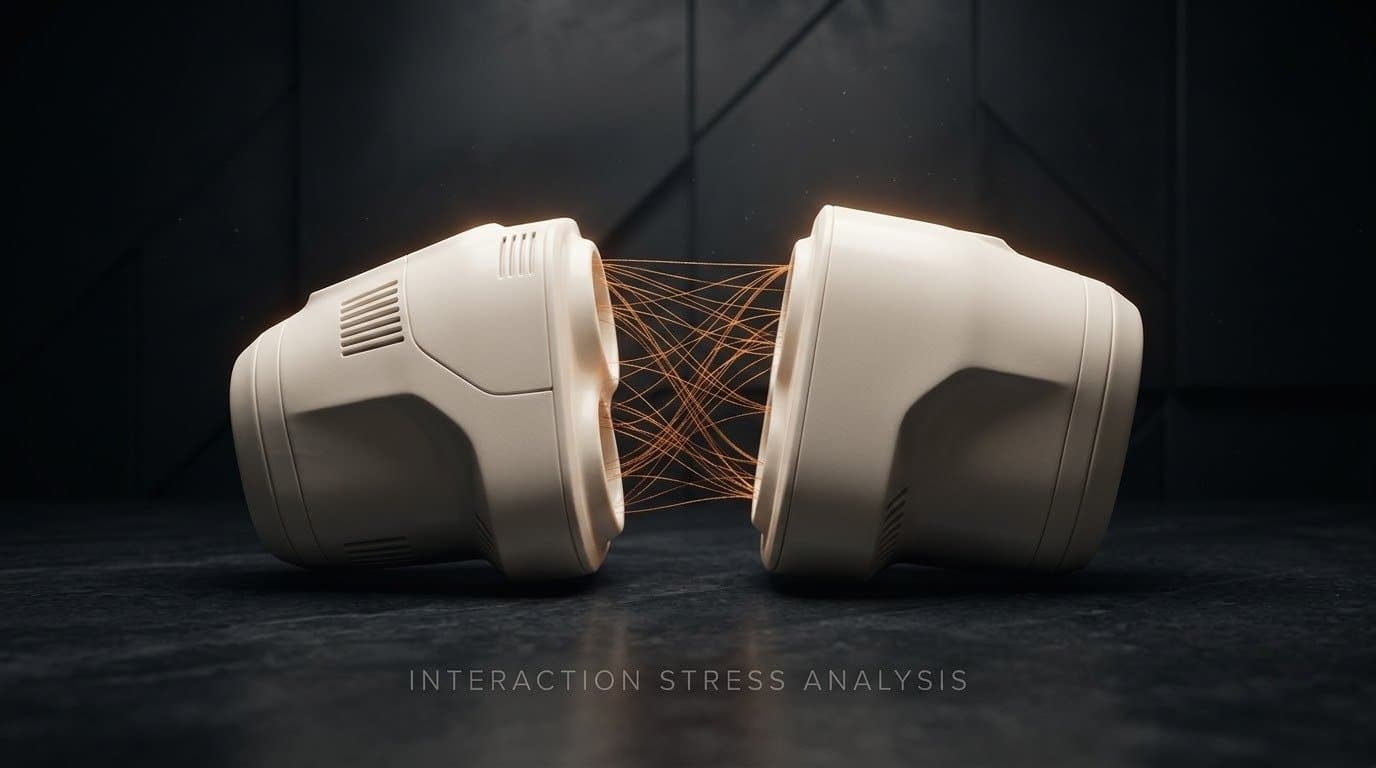
The challenge
Engineers struggled to anticipate complex electro mechanical failure modes arising from subtle thermal expansion, micro cable friction, and motor controller jitter.
Historical lessons learned from previous surgical robotic platforms remained locked in PDF post market surveillance reports and retired engineer notebooks.
An unpredicted cable tension fatigue failure occurred during late stage animal lab trials, requiring an expensive 6 month mechanical redesign.
How Tatvam solves it
AI Assisted Failure Mode Discovery Engine
Tatvam analyzes CAD assemblies and subsystem function trees, suggesting potential mechanical, electrical, and software failure modes automatically.
Historical Post Market Data Ingestion
Indexes historical FDA MAUDE adverse event databases and internal field service logs to surface known clinical failure mechanisms.
Cascading Multi Subsystem Failure Mapping
Models how a micro motor thermal spike propagates through gearbox backlash into surgeon haptic feedback latency.
Automated Risk Mitigation Recommendations
Suggests pre validated engineering mitigations (e.g., redundant optical encoders, dual channel current sensing) during early design.
Continuous Design Baseline Synchronization
Updates risk baselines automatically as CAD assemblies and component specifications evolve in PLM systems.
The outcome
- late stage prototype design redesigns reduced
- 0%late stage prototype design redesigns reduced
- accelerated DFMEA authoring velocity
- 0xaccelerated DFMEA authoring velocity
Uncovered 45 critical latent failure modes during early CAD modeling prior to physical prototype fabrication.
Late stage prototype design redesigns reduced by 70%, saving $1.2M in engineering rework costs.
Accelerated DFMEA authoring velocity by 3.5x using AI assisted failure mode suggestions.
Representative scenario: a modelled industry situation showing how this accelerator applies. Figures are projections, not a named client result.
Capabilities used
Every accelerator is assembled from the same capability layer, so a workflow you adopt here shares its foundation with the rest of the portfolio.
More from Tatvam
Quality & Compliance
Medical Device Design Risk Analysis & ISO 14971 Compliance
A medical device company developing an automated wearable insulin infusion pump and continuous glucose monitoring (CGM) system seeking FDA 510(k) clearance and CE mark certification.
Maintenance & Reliability
Thermal and Electrical Hazard Prioritization & Residual Risk Mitigation
An electro medical device manufacturer producing a high frequency electrosurgical generator and radiofrequency tissue ablation workstation.
Quality & Compliance
End to End Requirements to Design Verification Test Traceability
A neurotechnology enterprise developing an implantable neurostimulator and wireless patient controller for chronic pain management.
Bring us the version of this that you actually have.
Every engagement is fixed-scope and outcome-guaranteed. The scoping conversation starts with your systems, not with a template.